| |
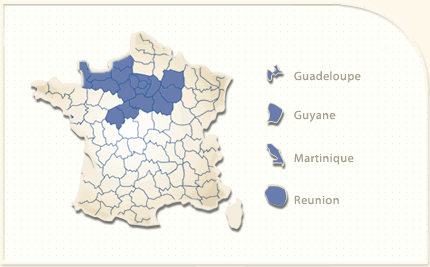
CRIDON de Paris is a regional organisation. |
 |
Each CRIDON branch has a territorial
footprint defined by the member Chambers. Because of this
limited territorial coverage the CRIDON branch is only
answerable to notaries employed by the member companies. This
territorial coverage is generally completed by the principle of
territorial continuity. By virtue of this rule, the authority of a
CRIDON branch may, in principle, be extended to all Chambers dependent
on a given regional Council. However in border zones this rule is not
always applied. |
|
The territorial coverage applies to
all CRIDON's consultation, documentation and training activities.
It extends to all the missions that are shared by the
five CRIDON branches. |
|
The rule of territorial coverage does not
apply to the publishing company (Editions du CRIDON) and Web
sites. Each
CRIDON branch is free to contact notaries throughout France to invite
them
as paid-up members, wherever their practice, to subscribe
to any of
the proposed publications. The only constraint is that a
CRIDON branch "canvassing" notaries outside its territory must seek
approval for its proposed conditions from the
administrative or supervisory
bodies. This limited
territorial coverage creates close ties between CRIDON and
notaries employed by member companies. It encourages
physical proximity. Because it is a
local, decentralised organisation, each CRIDON is based
at a location that is most convenient for the majority of notaries
employed by the member companies. |
|
A consequence of CRIDON's territorial
coverage and regional identity is that the size of each branch
is limited, and kept to a human scale. This would be a very
different situation if there were only one CRIDON in Paris. The
five-branch CRIDON network is clearly an optimal organisation,
enabling each branch to develop a "corporate culture" compatible with
local notarial practice. The consequence of this organisation has been
to keep the engagement of unproductive administrative personnel to a
minimum. This type of personnel overhead would most certainly have
been unavoidable if CRIDON had been a nationwide organisation. |
|
The existence of five CRIDON
branches
has also enabled the Notaries at regional level to keep control of
the institution they created by a committed act of membership. There
can be no doubt that voluntary contributors to
an institution such as CRIDON wish to maintain their influence on
this organisation. The regional nature of the organisation guarantees
this control. The situation would be very different if
there were only one national CRIDON located in Paris. A
Jacobin, centralised organisation would be less efficient,
unquestionably more costly to run and would be vulnerable to
the fluctuations and tensions that periodically typify the
life
of statutory bodies responsible for applying professional policies. Far
from being an issue of albeit illusory power, the CRIDON
exists to serve the interests of notaries. Their mission is to
represent and to a certain extent to protect them. |